
How Healthy Is Local Media in Central Virginia?
Posted November 13th, 2022 by EllaCategories: Programs
How do we get our news today? Are we really so divided as a country as some politicians and pundits suggest? How are stories covered (or not) in the face of media consolidation? And just how healthy is journalism in Central Virginia?
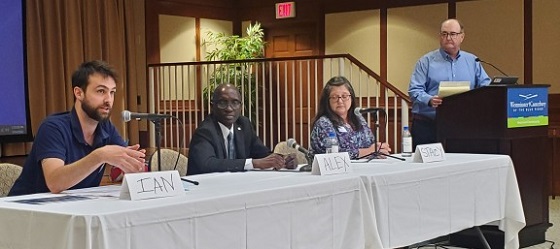
Giles Morris, executive director of Charlottesville Tomorrow, Jim Spencer, editorial page editor for The Daily Progress, and Joe Thomas, morning host and program director of Monticello Media, were panelists for the SSV November program. Dan Schutte of CBS 19 had a family emergency and was unable to attend. Bob Beard who is a former news anchor with CBS 19 in Charlottesville and a longtime reporter in Washington, D.C., including CNN, NBC and Reuters, was moderator.

Giles Morris, Jim Spencer, Bob Beard and Joe Thomas at the forum
These speakers were all passionate about their profession and trying to find the truth in the current media environment. Charlottesville Tomorrow is a non-profit electronic presentation funded by grants and donations whose primary goal is to present information to the community from a pure journalistic perspective. Jim Spencer focused on the challenges of corporate ownership and employing adequate reporters to cover our area. He currently has a staff of three. Wondering who writes the Progress editorials? He does. Joe Thomas explained the News Talk show title by saying first they present the News, and then the Talk portion is devoted to analyzing it. He also made a plea for community members to support advertisers of local media. The program highlighted common issues all media are dealing with today and how they try to provide local citizens with accurate information from which individuals may make informed decisions.
Participants
Bob Beard, SSV board member, moderated the program. Bob has over 30 years of experience in broadcast journalism at markets throughout the U.S. He is a former news anchor with CBS 19 in Charlottesville and a longtime reporter in Washington, D.C., including CNN, NBC and Reuters. Bob has degrees from Vanderbilt and Georgetown. Bob and his wife, Ellen, live in Ivy, where they raised twin sons. They are new “empty nesters.”
Giles Morris is the executive director of Charlottesville Tomorrow. He has worked as a school teacher, community organizer, and a nonprofit program manager. He started working as a full-time journalist in 2007 as the general assignment reporter for the Rhinelander Daily News in Rhinelander, Wisconsin. Giles served as editor-in-chief of C-VILLE Weekly and later as vice president for marketing and communications at James Madison’s Montpelier, where he was instrumental in the rollout of the award-winning, descendant-driven slavery exhibition, “The Mere Distinction of Colour.” He holds an M.Div. degree from Harvard Divinity School and his journalism and digital storytelling projects have been recognized by INN, LION, AAN, the North Carolina Press Association, and the Virginia Press Association.
Dan Schutte is the news director of CBS-19 and anchors CBS19 News at 5 and FOX Virginia News at 10. He started at CBS19 in June of 2006. He met his wife Alison here, and they now have a little girl named Abby. Abby keeps the family on their toes. She loves swimming and the family dog Ripley. Ripley joined the family from the CASPCA in 2015. Dan comes to the area from Northern Minnesota, where he was an anchor for WDIO-TV in Duluth. Prior to that, he was a reporter and anchor in Eureka, California. During his career, he has covered several national stories and won awards for his work. Dan is originally from the Minneapolis area. He graduated from American University in Washington, D.C., with a degree in broadcast journalism. He was also a member of the Division I wrestling team there.
Jim Spencer is the editorial page editor for the Daily Progress and appears weekly on Beyond the Headlines, a weekly news analysis segment on CBS19 in Charlottesville. A Virginia native, Jim has been a journalist since 1974. He began his career at the weekly Virginia Gazette in Williamsburg doing everything from writing news, feature and sports stories to writing theater reviews, sports columns and unsigned editorials. He moved to the Norfolk Virginian Pilot moving from sports writer, to news reporter to feature writer. The Chicago Tribune hired him to write features and he returned home to the Virginia Peninsula to write a metro column for the Daily Press after the Tribune Company bought the paper. He moved to the Denver Post to write a metro column and then to the Minneapolis Star Tribune where he served for 10 years as a Washington correspondent.
Joe Thomas is a Program Director and Talk Host at Monticello Media based in Charlottesville. Previously, Joe was a Co-Founder, Operations at The Afternoon Constitutional and also held positions at Charlottesville-Albemarle Technical Education Center, Forever Media, Delmarva Broadcasting, iHeartMedia, and Audacy, broadcast and Internet radio platform.
 Democratic candidate

 Delegate Sally Hudson represents Albemarle (part) and Charlottesville, and serves on the Finance Committee and the Health, Welfare and Institutions Committee. In 2019, she became the first woman to serve Charlottesville in the Virginia State House. In her first term, she delivered high-impact legislation to address some of the most pressing challenges we face, from unemployment and evictions to essential health care coverage. As a labor economist, Sally has invested her career in securing the resources and opportunities that every family needs to thrive.


 who is the Warner-Booker Distinguished Professor of International Law at the University of Virginia. Born and raised in Richmond, Virginia, Professor Howard is a graduate of the University of Richmond and received his law degree from the University of Virginia. He was a Rhodes Scholar at the University of Oxford, where he read philosophy, politics, and economics. After graduating from law school, he was a law clerk to Justice Hugo L. Black of the Supreme Court of the United States.
 Jill Trischman-Marks is a landscape architect with almost 30 years of experience in the Central Virginia area. Jill holds a Master’s Degree in Landscape Architecture from the University of Virginia. Projects she has worked on include the five original gardens at the Lewis Ginter Botanical Gardens in Richmond, the Thomas Jefferson Parkway in Charlottesville, and the Poplar Forest entrance road and trails in Forest Virginia.

 Elizabeth Beasley is in the Office for Diversity, Equity and Inclusion where she is director of community partnerships. In addition she is a member of the President’s Council on University-Community Partnerships and cochair of its Public Health Work Group. She began her presentation answering the question, “What is the difference between “equal” and “equity.” Equal implies that there is a one size fits all resolution to an issue. Equity is different in that it is an intentional way of equalizing responses according to the needs of the recipients. The goal of the President’s Council is to build partnerships with the community such as using local vendors, improving public health and public housing. Practicing good neighbor ethics, pursuing actions with mutual benefits and building authentic partnerships are ways of achieving equity between UVA and the local community.
 Putnam Ivey de Cortez from Albemarle County’s Office of Equity and Inclusion coordinates programs for the county government. The mission statement of this program is to improve the well being and quality of life for all community members. In order to accomplish this goal, understanding the issue more thoroughly is essential so, the speaker presented several demographic studies. For example, factors affecting health were found to be 20% clinical care, 30% health behaviors, 40% socioeconomic factors and 10% physical environment. These statistics provide the foundation for determining the work the staff is trained to do. Currently the county is revising their comprehensive plan and soliciting a broad selection of its citizens to give their input. If you are interested learn more and apply at engage.albemarle.org/AC44workinggroup.
 Bob Beard moderated the program. He is an SSV board member and a former news anchor with CBS 19 in Charlottesville and a longtime reporter in Washington, D.C., including CNN, NBC and Reuters.
 Ngiste Abebe is vice president of public policy at Columbia Care, one of the nation’s leading medical cannabis companies. She serves as the president of the New York Medical Cannabis Industry Association and on the board of the District of Columbia Cannabis Trade Association. Prior to that, she was co-founder of Undaunted Ventures, a political consulting firm which specializes in innovative narrative, training, and leadership coaching services, and which grew out of her work training progressive organizations and working on campaigns across Virginia. She is the co-founder and co-director emerita of New Leaders Council Virginia, a progressive leadership institute. Ngiste holds a BA in Public Policy from the University of Chicago and a Masters in Public Policy and Management from Carnegie Mellon University. She’s a NORML board member, vice president of Public Policy for Columbia Care (industry-leading medical marijuana dispensary) and newly appointed by Governor Northam to the Cannabis Public Health Advisory Board. She happily gives and receives recommendations for sci-fi novels and board games.