Archive for the 'Programs' Category

SSV Meeting Annual

Saturday, December 20th, 2025

Following our Annual meeting and Election of Officers on December 17 th , members began brainstorming possible topics and speakers for upcoming Senior Statesmen of Virginia programs. Now we would love to hear from YOU. What subjects, issues, or guest speakers would you find valuable, informative, or inspiring? This is your chance to suggest ideas—no topic is too small, and all perspectives are welcome. As a reminder, SSV is a nonpartisan organization committed to open, civil discussion. We want our programs to reflect the interests and curiosity of our community. If you have suggestions, please respond to this email, and I will be happy to share them with our Programs Committee for consideration.

Please consider inviting your friends, neighbors, or relatives to attend future programs. New voices and fresh ideas help keep our meetings engaging and relevant.

We look forward to your suggestions and seeing you at upcoming events!

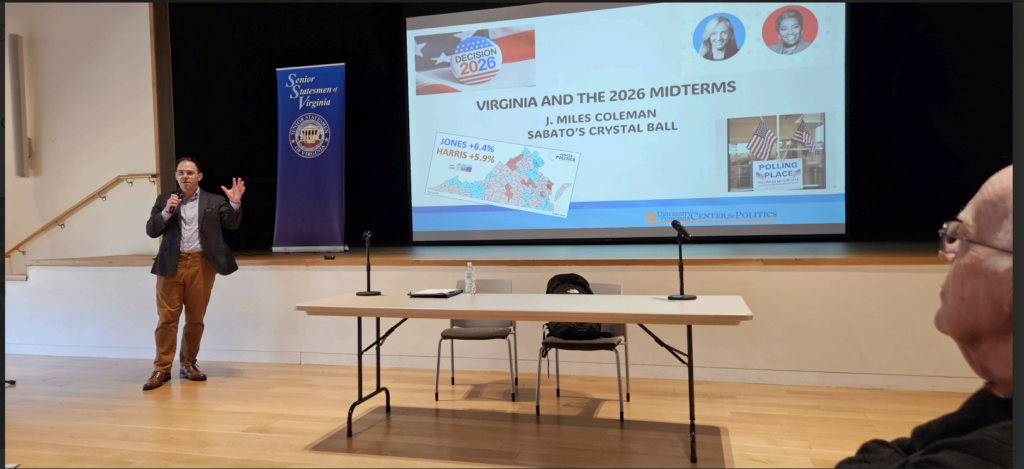
February 11 th – Election Insights: J Miles Coleman, Center on Politics at UVA and Associate Editor of Larry’s Crytal Ball, will discuss November Election results and provide some insight on polling related to upcoming issues and races in 2026.

March 11 th – Reducing Medicare Fraud: Shawn Smith, State Director for the Virginia Senior Medicare Patrol Program

April 8 th – Law of Armed Conflict: Lt. General Charles J. Dunlap, Director of International Law at Duke University

May 13 th – Virginia Assembly Update: Senator Creigh Deeds, Delegate Katrina Callsen, and Delegate Amy Laufer

Can Democracy and Capitalism Co-Exist?

Sunday, December 7th, 2025

SSV member, Margie Swanson, introduced the panel for today’s discussion on “Can Capitalism and Democracy Co-Exist?”  Professor Sid Milkis, UVA Department of Politics, moderated: Margaret Riley Darden, Professor of Law, Public Health Science and Public Policy at the Batten School of Leadership; Scott Miller, Assistant Professor of Business Administration at Darden Business School; and Michael Lenox, Professor of Business Administration at Darden School of Business.

The question:  Can the Rule of Law (Democracy) and Resources (Capitalism) Co-Exist?  Several pathologies get in the way: economic inequality, monopoly power, alienated voters, global trade and partisan politics. Eugene Debs (American socialist and labor leader), Bernie Sanders (US Senator, longest serving independent member of US Congress), and Marc Andreesen (The Techno-Capitalist Manifesto) are referenced as viewpoints on profit and democracy.  For more info, visit: Eugene V. Debs | Biography & Facts | Britannica; About Bernie » Senator Bernie Sanders; and The Techno-Optimist Manifesto | Andreessen Horowitz

Professor Lenox says, Yes, democracy and capitalism can co-exist…if we are watching against democracy moving to autocracy AND that capitalists don’t undermine the state (government).  In Russia, state controls most of the economy.  In China, capitalists are too powerful.  Both challenge/damage capitalism.

Professor Miller, a historian, notes that Americans have never agreed on the relationship between capitalism and democracy.  The logic of the market is not the logic of the family or society.   Henry George was viewed as dangerous by both the political right and political left. Henry George | Biography, Single Tax, & Progress and Poverty | Britannica Money. Our current issues are not different from the past, he notes.  Tho, the “haves and have nots” gap is increasing and polarization is the worst since Civil War times.

Professor Darden notes that the late 19th century and beginning of the 1900’s also saw these issues in America.  The definitions of capitalism and democracy are a key.

Biggest challenges?  Technology and technological inequality.  Education haves and have nots.  Identity and belonging.  Lack of mobility up and down the scale…..can people of wealth still “fall down.”  Alexander Hamilton and Teddy Roosevelt impacts on capitalism and democracy were noted.  For more info, visit: The Grand Strategy of Alexander Hamilton – AHS; and Capitalism and Labor – Theodore Roosevelt Center.

Are self-government and capitalism compatible?  Yes, says Professor Miller.  With checks and balances on democracy to avoid mob rule.  AND an active and competent citizenry.  Founders chose a democratic republic.  Since WWII, profound lack of trust in government institutions, notes Professor Darden.  Oligarchy and communications are too closely aligned.  And youth unemployment leads to revolution.  She believes Americans are willing to accept a solution that is more dramatic than usual. Another issue, says Professor Miller, hyper individualism of the 2000’s.  “Make yourself happy” origins from the 1980’s. 

Can we learn from others?  Denmark trains workforce for changes in economy.  Universal vouchers? What do we owe to each other? IF you answer “nothing,” you operate outside the American tradition. How do we return to…..who we are are/who we want to be? Collective purpose, how do we return to this? Everyone is a valued member of society. Shared values. Reasons to vote. People feel left behind…how to change? Rural areas….in history, electrification gave everyone a level playing field.  Would internet access across the country do this for today’s Americans?

Cyber Security and our Elections – Unpacking Fact From Fiction from so called “Cyber Experts”

Sunday, October 12th, 2025

Previous Image
Next Image

info heading

info content

SSV President Sue Liberman welcomed all in attendance and introduced SSV Board members. VP and Program Committee Chair Margie Swanson introduced today’s speaker, the Honorable Denver Riggleman, New York Times best-selling author of “The Breach,” former U.S. Congressman of Virginia’s 5 th District and current President/CEO of Riggleman Information and Intelligence Group.

Denver with his extensive background, experience and training in Intelligence and Risk Reduction, set about to educate us on the three burning topics in American democracy about the “DATA” involved – electoral security, election policies, meeting the challenge, and the debunked conspiracy theories such as “stealing the vote,” that surrounded previous elections. His first topic was to pose the question of who thought Virginia elections are fair, safe, and secure – but he did not have us answer – just think! He highlighted the state of this issue by pointing out that the money spent on data manipulation and misinformation is now the highest it has ever been in the history of our country. He challenged the audience to look more closely at the “news,” by questioning where the information came from, the source and how the conclusions put forth by the news reporter were reached. Denver reminded us that most election data is not connected to the internet and that to breach it would require hundreds of thumb drives in multiple locations to interfere. He covered all the conspiracies like ballot dumping, broken algorithms, mail in ballot fraud, illegal votes, and dead voters – emphasizing that none of these actually happened. In the case of so-called illegal votes, he pointed to the data that said in the history of US elections, .0003-.00025% or between 45 and 3750 votes were ever found to be fraudulent and thus never had a chance to change any election outcome. He did leave the thought in the air that officials have reduced resources (lowering the budgets of SISA, the FBI, the State Department’s GEC, and DOJ to investigate and prevent election insecurities) since the prior election to protect the 2026 midterm and the 2028 federal elections. Denver said that in today’s world, the need for more and better risk analysis for new and greater threats arise with increasing menace.

In parting, his personal thoughts were these: the inflammatory rhetoric and deployment of federal troops to America’s cities have had some intimidation effect but the backlash has been far greater – motivating people to protest and go vote. He hates bullies and he asked us to look closely at the disenfranchisement policies and procedures before the elections as he believes these are the tactics to best steal the vote. He fielded pointed questions from the audience about the “Prevention Paradox,” the oppressive feeling of “reciprocal data” and then he reminded us that there are 340 million Americans eligible to vote so hand-counting the ballots is unrealistic and unnecessary.

Sue Liberman made the following announcements regarding upcoming programming:
November 12 th – Can Democracy and Capitalism Co-Exist, UVA Professors Sid Milkas, Margaret Riley,
and Scott Miller bring their rich and relevant talents to answer the question.

December 17 th (please note this is the third Wednesday)- Annual SSV meeting and Election of
Officers. The meeting will be at the Center at 2:30 p.m., and will include refreshments, a request for Audience
Participation in small groups to aid in planning future programs

Charlottesville and Albemarle School Systems: Overview and Update

Wednesday, September 17th, 2025

Previous Image
Next Image

info heading

info content


SSV President Sue Liberman welcomed all in attendance and introduced SSV Board members.  She also extended a special welcome to SSV co-founder Gene Ecton Davis and her partner, Bill Davis.

After impressive introductions of Charlottesville City Schools Superintendent Dr. Royal Gurley and Albemarle County Public School Superintendent Matt Haas, the two speakers noted they collaborated on one presentation and one PowerPoint.

They began by providing basic facts about each school system: (24 schools serving 14,173 students in the County and 9 schools serving 4443 students in the City). They shared how the two superintendents work together with weekly calendar meetings scheduled, topical check ins as needed, monthly lunch meetings, and shared academic calendars.

FIVE FAST FACTS:

  • CCS is working on 1) modernization of facilities, 2) reconfiguration of the schools and attendance zones (first redistricting in 50 years), 3) invest in career pathways, 4) moving early childhood education from each elementary school to one school (likely Walker School building), and 5) xpanding learning alternatives for students (night school as example).
  • ACPS is working on 1) the new Mountain View Upper Elementary School building, 2) Career Exploration Academy at Albemarle HS, 3) Scholar’s Studio work-based learning programs, 4) safety (weapon screening, new school visitor mgt. system, School Resource Officers returning, school speed zones and school bus arm cameras), and 5) personal device-free schools.


They shared successes, challenges and opportunities, including support for General Assembly legislation that will allow for a 1% sales tax dedicated to school construction and a Virginia dedicated state fund for K-12 school construction, and a review of the Local Composite Index that drives funding to school divisions.  The LCI currently requires CCS to pay 77% of the cost of K-12 education and ACPS to pay 69% of the cost of K-12 education.


The public can share your views with:


Delegate Katrina Callsen – delKCallsen@house.virginia.gov, phone 804 698 1054;

Delegate Amy Laufer – delalaufer@house.virginia.gov, phone 804 698 1055, and

Senator Creigh Deeds – senatordeeds@senate.virginia.gov, phone  804 698 7511

Sue Liberman expressed appreciation for the informative program.  She then noted the upcoming programs:

October – Cyber Security and the Elections, Denver Riggleman

November – Democracy and Capitalism – Can they Co-Exist

December – Annual SSV meeting and Election of Officers.


Review of Local and State Initiatives Related to Protection of Our Environment With Focus on Emergence of Large Data Center Projects

Saturday, August 16th, 2025

The speakers were introduced by Board member Sandi Meadows, who moderated the session before one of the largest audiences for an SSV presentation. Morgan Butler, Senior Attorney, and, Associate Attorney, Christina Libre, began with a brief introduction to the Southern Environmental Law Center, a nonprofit, nonpartisan legal organization focused on land use, transportation, and other environmental issues. The SELC was founded in Charlottesville in 1986 and has now expanded its work to six southeast states.

The focus of this presentation was on the recent explosive growth of large-scale data centers in Virginia, beginning in Northern Virginia but now spreading elsewhere to include potentially in Albemarle County. They pointed out that data centers, which consist of stacks and stacks of computer servers in massive buildings, provide value to localities, to include tax revenue, but also have negative impacts on the environment and neighboring communities. Data centers require tremendous amounts of electricity as well as enormous quantities of cooling water and generate noise that is continuous and can be unpleasant to nearby residents. The need for on-site diesel generators, ostensibly only for emergency use, adds to the problems.

Localities control the approval of new data centers, but individual approval decisions do not necessarily consider the aggregate impact of many such facilities on communities. Construction of data centers on land already zoned for industry can be by-right, as was recently the case in Albemarle County, or localities can pass ordinances requiring individual review of each proposal. A draft Albemarle ordinance has strong features regarding screening and restrictions on auxiliary power emissions but would designate four County districts that would permit establishment of large-scale data centers by right. The SELC believes this would be a mistake that would not allow public input. Maps were displayed of each of the proposed sites, all of which were shown to be near residential developments.

Questions following the presentation focused on why square footage was used to determine the scale of data centers and whether the cooling water would be recycled. The issue of requiring use of solar and other environmental energy sources was raised and the speakers pointed out that this would not be possible to do on- site and, furthermore, that localities do not have the authority to regulate energy uses. Another raised the interesting question about the potential for technological advances that could render these facilities obsolete and white elephants that localities would have to deal with.

Annual General Assembly Update 2025

Friday, May 23rd, 2025


Previous Image
Next Image

info heading

info content


For the SSV May 14th program, Board member Sandi Meadows welcomed everyone and introduced Board member Jim Nix, who invited Senator Creigh Deeds, Delegate Katrina Callsen and Delegate Amy Laufer to share the eagerly awaited General Assembly update.

With 25 years in the VA Senate, preceded by 9 years in the VA House, Creigh Deeds holds valued seniority in representing all of Albemarle County and the City of Charlottesville.  He chairs the Commerce and Labor Committee and well as the Health and Human Services subcommittee.  Service on the impactful Budget Conference Committee was noted. 

Overview of the Budget: 

Of the $161 billion two-year state budget, just $60 billion is discretional or general fund revenue.  $101 billion is mostly federal funding.  Virginia hosts 300,000 federal employees, the military installation in Hampton Roads, plus 100,000+ contractors who support federal/military services.

Virginia’s $4.7 billion “rainy day” fund is a “drop in the bucket” when you consider $101 billion in federal funds potentially at risk.

Senator Deeds stated that his areas of interest are:  mental health, schools, energy, and solar. He said that, given the cuts made by the new administration, many representatives are looking for additional streams of revenue should a shortfall ensue. He addressed VA’s love affair with data centers. Loudon County is the world leader in data centers because of tax incentives given in the past. A bipartisan study group is looking at fixes should any of these data center operator’s flop.

Delegate Callsen highlighted several constituent amendments and pharmacy benefit manager legislation. This session she supported automatic placement in advanced math for those who score well on tests. She noted that the final budget has a record amount of support for education, including teacher raises.  Delegate Callsen emphasized the importance of the Attorney General election.

Delegate Laufer expressed focus on tire and mattress recycling, asphalt recycling, and purchase of regional electricity purchasing.  Another priority of hers is the “dam” bill as there are 1300 dams in the 55th Delegate District, with many along Highway 15.  She also worked for confidentiality of personal information in the public-school enrolment process and continues to serve on the Rural Health Care subcommittee, where health care is a key.

Several questions were answered on Medicaid, teacher pay/retention, math teacher shortage, data centers, and car idling legislation.

Delegates Callsen and Laufer presented SSV a Resolution of Recognition in celebration of 30 years! SSV Founder Gene Ecton Davis was on hand to enjoy in the festivities. 


Embracing Optimism In Uncertain Times

Thursday, April 17th, 2025


Russ Linden, a management educator and author who specializes in organizational change,  presented a timely program on “How to Retain Optimism During These Troubling Times” He shared that optimism  is a state of mind that is;
–hopeful about the future
–focuses on the positive side of things
–believes you can make good things happen

Optimists live longer, have better physical and mental health, recover faster from illness, are more resilient, have a better sense of well-being and are more engaged at work. Optimists inspire others.

Balanced optimism is best when optimism is balance with realism.

How can you promote Optimism in yourself?
1) reflect on things that bring you down and seek alternatives
2) reframe!
3) connect with peoples and activities that give you energy…positive energy.
4) be forgiving if yourself and others…
Give up perfectionism
5) keep the focus on your …keep the main thing the main thing
6) see attitude as a Choice

Final thoughts on balanced optimism:

Success isn’t final.
Failure isn’t fatal.
It’s the courage to continue that counts!
— Winston Churchill


Embracing Optimism In Uncertain Times


Ranked Choice Voting in Central Virginia

Thursday, March 20th, 2025

Previous Image
Next Image

info heading

info content


Sally Hudson is the founder of Ranked Choice Virginia and former Delegate representing Charlottesville in the General Assembly.  In that role, Dr. Hudson authored the legislation that allows Virginia cities and counties to use ranked choice voting (RCV).


We learned that Arlington County has had RCV in two elections, with positive responses from candidates and voters.  Charlottesville will use RCV for the June 17th City Council primary election.  Albemarle County is considering RCV for this year’s Board of Supervisors election, as is Falls Church and Loudon County. The Virginia Republican party has used ranked choice ballots at conventions to nominate candidates for statewide offices and three Congressional districts…Fourth, Tenth and Eleventh.


Beyond Virginia, Alaska and Maine use RCV in all of their state and federal elections. In addition, more than 50 cities and counties use RCV in local elections, from big cities like New York City and Minneapolis to small towns in Utah, Colorado, and Vermont. In 2024, DC voters overwhelming supported a ballot measure to adopt RCV for their elections, too.

RCV can be easily used in an election seeking one winner… or an election seeking multiple winners… like the Charlottesville City Council.

RCV allows each voter to show their preference for each candidate.  The benefits:   Voters get real choices. Candidates run better campaigns. Communities get representative leaders.

The main cost of using RCV is voter education. The current election equipment is already compatible with RCV.

Dr Hudson provided an opportunity for the 40 attendees to experience RCV as they shared their opinions on 5 top local issues:  education construction, housing, natural resources, public safety and transportation.

To learn more… and see examples… visit rankedchoiceva.org


Picking up the Pieces: Data-Driven Takeaways from the 2024 Election

Sunday, January 12th, 2025

Previous Image
Next Image

info heading

info content

The January 2025 program was led by J. Miles Coleman, Associate Editor of Sabato’s Crystal Ball at the University of VA Center for Politics. Miles crafted very illustrative slides and prefaced his talk with the caveat that “traditional indicators” in analyzing elections were “out the window.” To our rapt audience of about fifty-five people, Miles turned first to Oceola County, Florida and said that “things began to go haywire for Harris there.” The numbers showed that county went 60% for Biden in 2020 but went narrowly for Trump in 2024. Closer to home, he looked at Loudon County, Virginia, where data had Harris carrying the vote by a 17% margin, this was down from Biden’s 20% in 2020. He and others were shocked that all the so-called “toss up states” went for Trump, especially in view of how well Democrats had done in the off-year elections. He attributed the difference to “Trump’s strength in getting voters who do not regularly vote to the polls to vote for him,” and remarked that there is a “Global Anti-Incumbent” view. Pre-election polls showed Americans likely to vote were evenly concerned about the economy and the future of democracy. His summarized that the 2024 Presidential election numbers showed Trump did better everywhere, even in California and New York, where democratic majorities were smaller. Miles expressed that the bell-weather governors’ elections in New Jersey and Wisconsin might be “markers” for America’s future direction.

Miles said Trump’s mandate is to “not mess up” and that Democrats must reach out in a meaningful way to the minorities that fled the party last year. He pointed out that “ticket splitting” was rarer and rarer. To keep the Senate from becoming staunchly in the column of the GOP, Miles suggested that the Democrats might focus on races in Maine and North Carolina, and on keeping Ossof in Georgia. He said the House is still remarkably close and that the Democrats gained 2 seats.

Finally, Miles looked at Virginia Governor’s races, saying that Spanberger probably has the Democratic nod and Winsome-Sears, the Republicans. Miles pointed out that Virginia is going to have a woman governor, and cautiously opined that if the mid-term elections go as in the past, the Democrats might “flip” the US house back in 2026. Miles ended his presentation by taking questions from the audience.

Part 1-Annual Business Meeting; Part 2-Susan Tate – Joyful Wellness: Cherishing your mind, body, spirit & sexuality at any age; and Part 3-Celebration of SSV 30th Anniversary Honoring Gene Ecton Smith Davis, Founding Member

Monday, December 23rd, 2024

Previous Image
Next Image

info heading

info content


The December gathering began with the Annual business meeting. The Program Committee and the President shared reports. The Nominating Committee recommended the following directors for election: Sue Liberman for a renewal term of 2 years; five new members for 2-year terms each: Dr. Charles Chick Dassance, Dr. Frank Friedman, Ms. Connie Jorgensen, Ms. Sue Lewis and Ms. Sandi Meadows. Secretary Bonnie Brewer confirmed a quorum. All were elected by unanimous vote, to join continuing SSV Board members: Grant Brownrigg, Ella Jordan, Jim Nix, and Margie Swanson. Officers nominated and unanimously elected were: President, Sue Liberman, Vice President/Programs Margie Swanson, and Treasurer Jim Nix. The Secretary position remains open.

Part 2 of the meeting was a relaxing and thought-provoking program by Susan Tate on Wellness, health, and sexuality for seniors.  Many valuable strategies and activities were shared, including staying physically and mentally active, meditating or simply taking time to reflect, reframing our words, resisting aging stereotypes and negativity, and pursuing/valuing personal connections. All 50+ in attendance were touched.

Part 3 of the meeting was a heartwarming and most deserved recognition of Gene Ecton Davis…one of the 5 individuals who founded SSV in 1995.  President Sue Liberman shared an impressive and moving snapshot of Gene’s awesome contributions to our community and other communities.

See our website for the full text. The SSV Board is honored to make a personal donation of $200 to The Center library for the purchase of books in honor of Gene Ecton Davis.


Previous Image
Next Image

info heading

info content