Criminal Justice Reform- A Dialogue
Posted January 15th, 2021 by EllaCategories: Programs
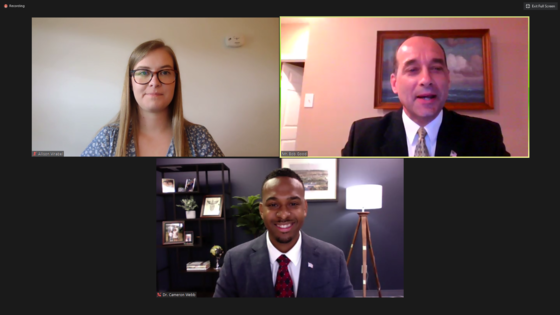
Our January program featured the Commonwealth’s Attorneys from Albemarle, James Hingeley, and Charlottesville, Joe Platania. They discussed the recent changes in law as passed by the 2020 General Assembly and some of the proposals being put forward for the upcoming session. Jeff Gould, president, Senior Statesmen of Virginia, moderated the discussion and took questions from the Zoom participants.
Click to watch the Zoom recording. The podcast can be obtained below.
 James Hingeley took office January 1, 2020, as the elected Commonwealth’s Attorney for Albemarle County and is a member of Virginia Progressive Prosecutors for Justice. He served as public defender for Albemarle County and Charlottesville from 1998 to 2016, and was public defender for Lynchburg, Virginia, from 1991 to 1998. From 1978 to 1991 he was in private practice in Charlottesville. After graduation from UVA Law School in 1976, he completed a two-year judicial clerkship for the West Virginia Supreme Court. Hingeley is a 1969 graduate of Harvard.
In 2005, Hingeley was named a fellow of the Virginia Law Foundation, and in 2008 he was named a Wasserstein Public Interest Fellow at the Harvard Law School. In 2014 he received the Virginia Bar Association’s Roger D. Groot Pro Bono Publico Service Award, and in 2017 he received UVA Law School’s Shaping Justice Award for Lifetime Achievement in Public Service. Hingeley has served as president of the Virginia Association of Criminal Defense Lawyers and the Virginia Fair Trial Project. He served on the Board of Governors of the Virginia Bar Association and was a member of the Virginia State Bar Criminal Law Section Board of Governors. In 2013 he was elected to Bar Council, the governing board of the Virginia State Bar, representing the 16th Judicial Circuit. In 2016, Govenor Terry McAuliffe appointed Hingeley to a three-year term as a member of the Virginia Indigent Defense Commission.
 Joe Platania graduated from Washington and Lee School of Law in 1998 and started his legal career at the Virginia Resource Center where he represented Virginia inmates that had been sentenced to death.
He came to Charlottesville in 1999 as one of the original attorneys at the then newly opened Charlottesville-Albemarle Public Defenders Office. Platania joined the Charlottesville Commonwealth Attorney’s Office in 2003 and was elected Commonwealth’s Attorney in 2017. He was a cross-designated special assistant U.S. attorney for the Western District of Virginia from 2008-2017. In addition to his duties as Commonwealth’s Attorney, Platania currently serves on the Board of Governors of the Virginia State Bar’s Criminal Law Section and is the board president of the Charlottesville Albemarle Drug Treatment Court. He is the vice-chair of the 7th District Disciplinary Committee of the Virginia State Bar and is the director of the Prosecution Clinic at the University of Virginia School of law. Platania is also a member of the Virginia Criminal Justice Conference which is an organization that seeks to improve criminal justice in Virginia by assembling selected legal professionals and stakeholders in the field of criminal law to study and discuss issues of interest, to gather information, and, when substantial consensus can be reached, to propose legislation or rule changes to effect reform of criminal law and criminal procedure.
Program Summary
How did two men with criminal defense attorney backgrounds become Charlottesville and Albemarle County commonwealth attorneys? Jim Hingeley (county) and Joe Platania (city) spoke at the January 13th meeting and explained how this came to pass. Then for the remainder of the session answered questions from the audience. Both men agree that their backgrounds led them to better understand why crimes were committed and addressing those challenges would reduce criminal behavior. They see their roles as prosecutors as balancing the safety of the community with the rights of the defendants. These attorneys are both known as “progressive prosecutors” and hope that their philosophy will lead to criminal justice reform.
They reviewed new laws passed in the 2020 General Assembly including the banning of police from executing unannounced warrants, using choke holds, or conducting searches based on the smell of pot. Other new laws include empowering localities to form police civilian review boards with the power to subpoena and impose punishments. Juries will decide guilt or innocence, but no longer be imposing sentences. Judges will assume sentencing as they can have more knowledge and a better understanding of the law. Also, in certain categories, prisoners can earn good time credit and reduce their sentences.
In response to questions about the effect of the pandemic, both men agree that trying to reduce jail population has been a goal. A collaborative group including attorneys, jail personnel, judges, OAR, and clerks as well as program services providers work together to find alternatives to serving jail time has met with success while keeping the public safe.
The commonwealth attorneys agreed on most subjects discussed. Both feel that there are bigger priorities than prosecuting pot infractions; that judges should be deciding sentences rather than mandatory sentencing for convictions; that the death penalty should be ended. Both men are interested in seeing the details of the bills promoting the expunging of nonviolent records and ending parole before forming opinions.

 Al Christopher has been director of the Energy Division of the Virginia Department of Mines, Minerals and Energy since March 2009. For about four years prior to that he was executive director of Virginia Clean Cities, a nonprofit coalition that promotes alternative fuel and electric vehicles. Al was a second-generation fuel distributor and a newspaper editor and reporter, working in Hampton VA; Tampa FL; and Washington DC. He has a B.S. in mass communications and an MBA, both from Virginia Commonwealth University.
 Michael Skiffington is the director of policy and planning for the Department of Mines, Minerals and Energy. He serves as the agency’s primary liaison to the General Assembly, as well as being the agency’s regulatory coordinator since January 2010, Michael also leads the agency’s strategic planning team. A lifelong Virginian, he received a bachelor’s degree in Business Administration from Old Dominion University and a law degree from George Mason University. An avid musician since the age of eight, Michael lives with his wife in downtown Richmond, anxiously awaiting the return of live music.

 Brian Cannon was the executive director of OneVirginia2021 for five years and lead their grassroots, nonpartisan organization in lobbying legislators to pass a constitutional redistricting reform amendment. Brian is now the executive director of FairMapsVA, a ballot campaign dedicated to educating Virginians about Amendment 1 and urging them to vote yes to end partisan gerrymandering in Virginia.
 Christopher Ambrose is a small business owner from Fairfax County and has been a longtime community activist and long-standing advocate against gerrymandering. Mr. Ambrose supports independent redistricting and is a founding member of Fair Districts Virginia, a grassroots group that supports independent redistricting and opposes the constitutional amendment.


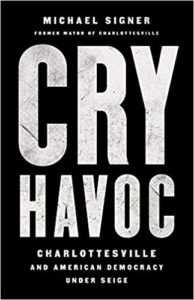 The deadly invasion of Charlottesville, Virginia, by white nationalist militias in August 2017 is a microcosm of the challenges facing American democracy. No one is better placed to tell the story of what really happened, and to draw out its larger significance, than Michael Signer, then Charlottesville’s mayor. His new book,
 Peter Thompson joined The Center in 1999. A resident of Charlottesville for more than 40 years, he received his undergraduate degree from the University of Virginia and his MPA with a concentration in nonprofit management from VCU.
 The Center on Hillsdale Drive is now closed and the new Center at Belvedere is opening in April 2020. The Weldon Cooper Research Group was hired to study the case for an expansive vision for the center as a vibrant facility with an ambitious outreach plan. The senior population of our area has increased from 24,488 in 2000 to estimated 42,791 in 2020.
  The
The